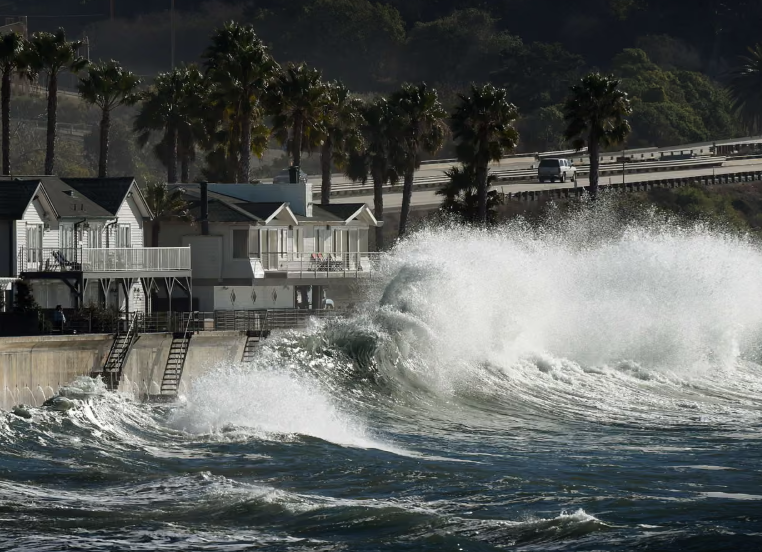
El Niño, a recurring climate phenomenon marked by above-average sea surface temperatures, when changes in wind patterns allow warmer water to spread across the central and eastern equatorial Pacific, could spell a wet winter for portions of the western and south-eastern US, climate models show. Coastal areas may be at elevated risk of flooding, experts warn.
Climate scientists predict this year’s “super” El Niño, a label assigned when sea surface temperatures climb by at least 2C, will be the strongest of the century. The weather system is expected to intensify in the fall and winter, persisting until early spring 2027, according to the US National Oceanic and Atmospheric Administration (Noaa).
A woman carries a child on her back through a field of dried-up maize plants
El Niño could push 50m people into acute hunger before end of next year
Read more
California has a 70%-100% chance of experiencing above-average rainfall along its coast, according to a model from the European center for medium-range forecasts.
“El Niño is never going to guarantee any particular outcome in any California winter,” Daniel Swain, the UCLA climate scientist, noted at a virtual El Niño town hall hosted by the California state senator Mike McGuire this week. But, he added, a weather event as strong as the one being currently predicted shifts the odds in favor of a wet winter: “That will likely affect and increase the likelihood of coastal flooding, particularly during strong storm events or during king tide events.”
California has been devastated by El Niños in the past.
A 1982-83 weather system destroyed 33 oceanfront homes and damaged 3,000 other residences, according to the California coastal commission. In a 1997-98 El Niño, California experienced massive flooding and 17 storm-related deaths. In more recent history, during the El Niño winter of 2015-16, state officials reported record coastal erosion on California beaches.
“With less beach in front of the coastline, the waves will have even greater impact on the shoreline with more likelihood of flooding and undercutting of cliffs,” said Mark Merrifield of the Scripps Institution of Oceanography, at McGuire’s town hall.
El Niño is not expected to completely erase drought in the US south-west, where some reservoirs are at an all-time low. “It would have to be exceptionally wet,” Dr Joel Lisonbee, senior associate scientist at the Cooperative Institute for Research in Environmental Sciences at the University of Colorado Boulder, told the Guardian in June. “That would also mean flooding, and the destruction and potential loss of life that comes along with that.”
Swathes of the US Gulf coast and east coast, stretching from Florida up to the mid-Atlantic region, are facing similar high odds of increased precipitation.
During El Niño years, central and south Florida has historically experienced more severe weather with more tornadoes and flood events, according to Noaa. In a 1998 El Niño winter, an outbreak of unusually strong tornadoes in that region led to 42 deaths and more than $100m in damage.
Experts warn that not every El Niño behaves the same, nor does it affect different geographical regions in the same way. Some have fueled hurricanes and heavy precipitation, while others have triggered extreme heat and drought.
While this is “a natural cycle”, Merrifield said at the town hall, the potential effects of a temporary sea-level rise in California from the super El Niño also “gives us a bit of a stress test of what the state is likely to experience with future climate change”.
“The El Niño, I think, is a good opportunity to sort of see where our vulnerabilities are throughout the state and what we can do to prepare,” Merrifield added, “and it also is a sobering look at what we can expect with climate change.”
We know this is annoying … but this is your last chance to claim 50% off
Seeing these messages can be repetitive. We know that. (Imagine what it’s like writing them … )
But it’s also extremely important. One of the Guardian’s most valuable assets is its reader funding.
1. Reader funding means we can cover what we like. We’re not beholden to the political whims of a billionaire owner. No one can tell us what not to say or what not to report.
2. Reader funding means we don’t have to chase clicks and traffic. We’re not desperately seeking your attention for the sake of it: we pursue the stories that our editorial team deems important, and believe are worthy of your time.
3. Reader funding means we can keep our website open, allowing as many people as possible to read quality journalism from around the world – especially those who live in places where the free press is in peril.
Right now, the Guardian’s work is funded by just 2.4% of our regular readers. We know that not everyone can afford to pay for news, but if it would help to convince people like you from Cambodia to support us, for a limited time, we’re offering 50% off for six months or 50% off an annual subscription to All-access digital and Digital plus. All-access digital gives you an enhanced, ad-free Guardian experience, while Digital Plus includes all the benefits of All-access digital, along with our 200-year archive, and digital versions of our daily newspaper and the Guardian Weekly.